
VW Floor Pan Replacement: The Complete Guide
- Key Takeaways
Floor pan rust is the most common structural issue in VW Beetles (1946–1979) and Split Window Buses (1950–1967) — treat it as structural, not cosmetic. - Both full pan replacements and section patches are valid — the right choice depends on how far the rust has spread.
- VW Buses require extra care due to their unibody construction — floor pan damage often ties into rocker panels and B-pillars.
- Quality reproduction pan sections are available for most models; fit and finish varies widely by supplier.
- A professional shop can assess, cut, weld, and seal a new floor in ways that preserve structural integrity long-term.
Why Floor Pans Fail — and Why It Matters
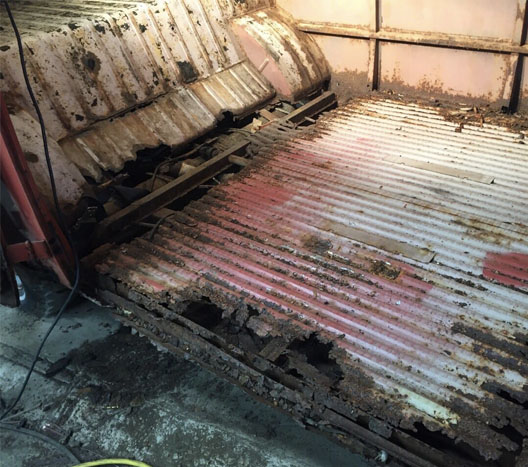
Volkswagen’s air-cooled models were engineered brilliantly for their era, but their floor designs created a perfect rust trap. The flat pan sits low to the ground, collects road moisture and debris, and on Split Window Buses in particular, the channel sections running front to back can hold standing water for years without the owner ever noticing.
On a VW Beetle, the floor pan is a structural backbone — the central tunnel and floor sections are load-bearing. A rusted pan doesn’t just look bad; it compromises the rigidity of the entire chassis. On a Split Window Bus, the situation is even more critical. The Bus is a unibody vehicle, meaning the floor IS the structure. When the floor goes, the rocker panels, B-pillars, and door frames follow.
Safety Note
Many VW Buses and Beetles with visible surface rust on the exterior have hidden structural rust in the floor that isn’t visible without lifting the vehicle and removing interior panels. Always have a professional inspection before assuming the damage is cosmetic.
Diagnosing Floor Pan Damage
The first step is knowing what you’re dealing with. Surface rust — reddish-brown staining on otherwise solid metal — is very different from structural perforation, where the metal has thinned to paper or disappeared entirely.
Step 1 - Lift and inspect from below
Put the vehicle on jack stands or a lift and inspect the underside. Inspect suspect areas with a screwdriver — healthy metal resists; rust-weakened metal flexes or punctures easily.
Step 2 - Remove interior flooring
Pull up carpet, sound deadening, and floor mats. Hidden rust often lives under these layers, invisible from above until the material is removed. Lift your front rubber mats and you can usually see rust damage immediately if you have it.
Step 3 - Check the heater channels (Bus)
On Split Window Buses, the heater channels running along the floor edges are notorious rust traps. If these are compromised, the scope of the repair expands significantly.
Step 4 - Assess the central tunnel (Beetle)
The backbone tunnel in the Beetle carries structural load. Rust here is more complex than side panel rust and requires precise fabrication or replacement to repair correctly.
Full Replacement vs. Section Patching
The two primary approaches to floor pan repair each have their place depending on the severity and location of the damage.
Section Patching
When rust is isolated to a defined area — say, one quarter of the driver’s side floor on a Beetle — a properly executed patch panel is a legitimate, durable repair. The patch must be butt-welded (not lap-welded over the rust), the edges ground flat, and the repaired area fully treated and sealed before any finish work.
Full Pan Replacement
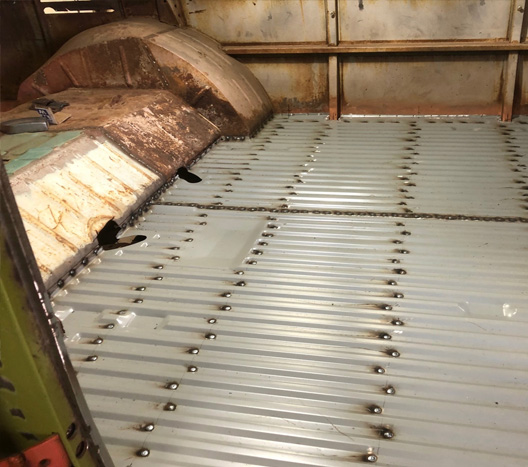
On heavily rusted vehicles, or Buses where the damage has spread to multiple bays, a full pan replacement is the cleaner, longer-lasting solution. Reproduction floor pans are available for most Beetle model years and for Split Window Bus configurations. Quality varies considerably between suppliers — the gauge of the steel, the accuracy of the stamped channels, and the fit at the factory seams all differ. We can help you navigate what our preferred replacement panels are by model type and year.
Note on Reproduction Parts
Not all reproduction floor pans are created equal. At Silverlining, we test-fit panels before welding and correct any dimensional issues before the pan goes in permanently. A panel that’s off by a few millimeters at the seam creates fit problems for every component above it.
The Replacement Process — How We Work
At Silverlining, every floor pan job follows a consistent process designed to produce a result that outlasts the original.
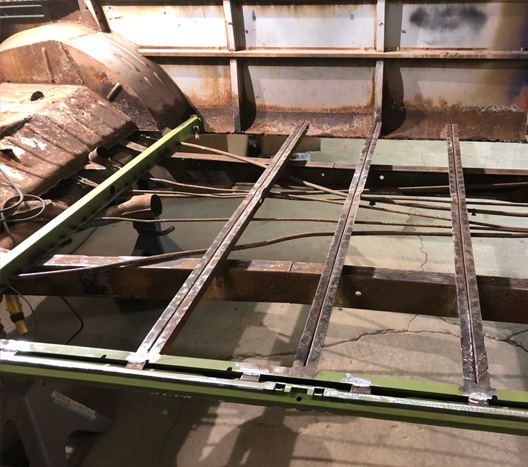
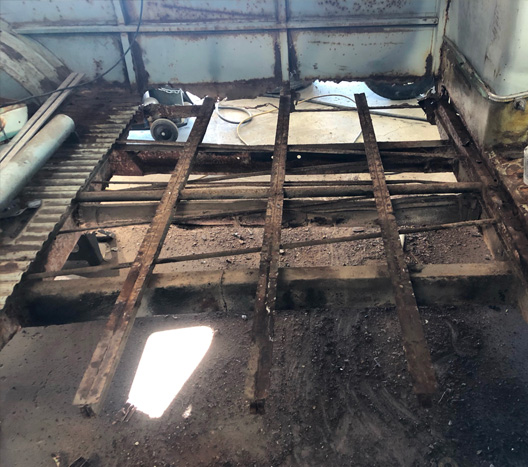
Step 1 -Strip and assess
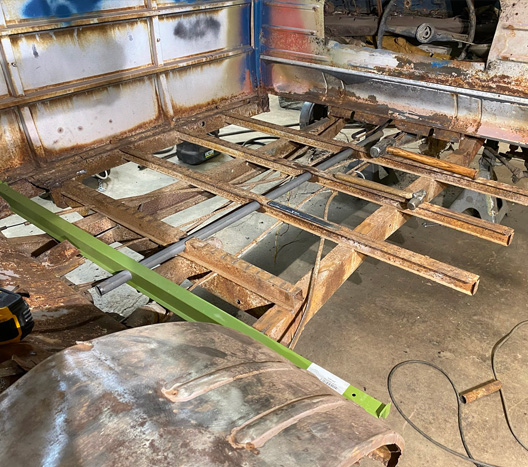
Full interior removal, undercoating stripped, and a complete structural assessment before any metal work begins. Surprises discovered early are far less expensive than surprises discovered mid-job.
Step 2 -Cut to clean metal
We cut back to solid, healthy material — not just past the visible rust. Rust migrates further than it appears; our cuts go past the stain line every time.
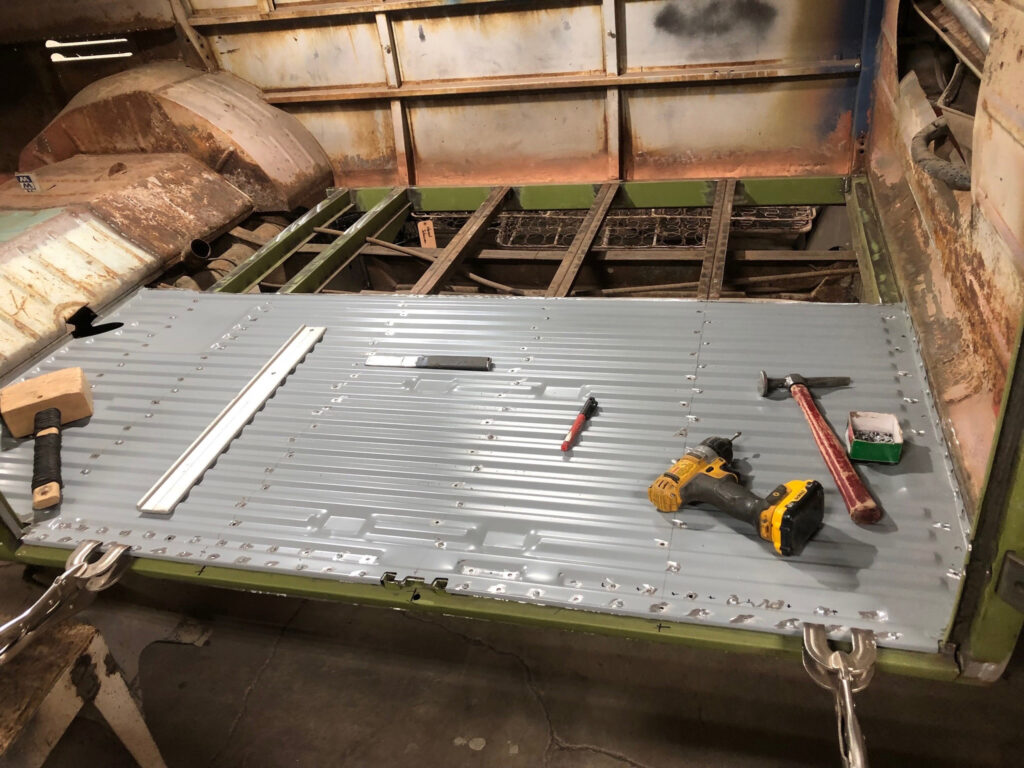
Step 3 - Fit and weld
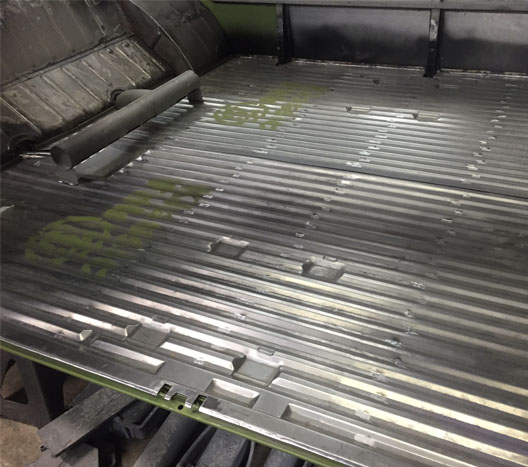
New pan sections are test-fitted, adjusted, and MIG-welded in place. On Bus restorations, we monitor door gap and body alignment throughout — unibody flex during welding is real and must be managed.
Step 4 - Treat and seal
All new metal is etched, primed, and sealed from both sides before any interior or undercoating goes back on. We use cavity wax on all enclosed sections — including heater channels on Bus restorations.
Special Considerations for Split Window Buses
The Split Window Bus (1950–1967) deserves its own section because it presents unique challenges. Unlike the Beetle, which has a separate chassis and body, the Bus is a unibody construction. Every structural member connects. This means floor pan work on a Bus often has a cascading effect — what starts as ‘just the front floor bay’ reveals compromised B-pillars, rotted rocker seams, and heater channels that haven’t seen daylight in decades.
We recommend treating any Bus floor job as a full structural audit. The cost of discovering B-pillar rot after the new floor is already welded in is much higher than finding it during the initial assessment and addressing it as part of the same job.
How Long Does It Take — and What Does It Cost?
Floor pan replacement is skilled fabrication work, not a bolt-on job. On a Beetle with moderate damage requiring section patches, a typical job runs 20–40 hours of shop time depending on how far the rust has spread and what’s discovered once the interior is out. A full Bus floor replacement on a vehicle with significant corrosion is a 60–120 hour job when done correctly, especially when heater channels and rocker seams are included.
We quote every job after a physical inspection — not over the phone. The variables are real, and a shop that quotes without looking is guessing.
Ready to Talk About Your Bus or Beetle?
Our metal shop specializes in structural restoration for Split Window Buses and classic Beetles. We’ll assess your vehicle, walk you through the scope, and give you a straight answer on what it takes.
See Our Completed Builds
Call Us: 503-580-1228 | silverliningautorestoration.com